
Chapter 1 · p. 8
The Origins of KH. Ibrahim and the Story of His Life
KH. Ibrahim was the first son of the first wife of KH. Ghozali bin (son of) K. Nawawi (Majasem) bin K. Khotib Anom (Srigading-Kalambret-Tulung Agung) bin K. Anom Besari (Kuncen-Caruban-Madiun) bin P. Satmata Al-Alim, also known as K. ’Arobi (Surabaya).
He was born in the village of Cokromenggalan, about 2 km west of the town of Ponorogo (the old town), or, as it is today, about 2.5 km east of the town of Ponorogo, in 1812, to KH. Ghozali and Ny. Majasem.
Chapter 2 · p. 8
Hajj and Studying as a Santri in Makah
While still a child, KH. Ibrahim studied diligently under his own father, learning to read and write Arabic script, because at that time there was not yet any formal education such as exists today. Above all, he studied the Al-Qur’an, for KH. Ghozali, Ibrahim’s father, was an ‘alim (learned scholar) and a hafidl (one who has memorised) of the Al-Qur’an, and had his own pesantren (Islamic boarding school) in the village of Cokromenggalan. On reaching adolescence, Ibrahim was sent to board at the Tegalsari Pesantren in Jetis, Ponorogo, about 8 km south of his village, which at that time was led by K. Ageng Raden Hasan Besari. Among its santri (students) at that time was Raden Ngabai Ronggowarsito, a poet of the Solo palace who remains very famous to this day. It is said that on returning from Tegalsari, Ibrahim’s learning was fairly sufficient, so his father assigned him to help teach at the family’s own pesantren in Cokromenggalan. As he grew older, his father matched him with a female santri of the pesantren named Ny. Sudjinah. This female santri was very diligent, tawadlu’ (humble) and obedient in her service to her kyai (teacher). For this reason K. Ghozali took her straight away as his daughter-in-law, and around 1840 CE Ibrahim fulfilled the fifth pillar of Islam, the hajj pilgrimage, setting out for the holy land of Makah al-Mukaramah without his wife accompanying him.
For his journey to the holy land to perform the hajj in Makah he travelled by sailing ship from the port of Tanjung Perak, Ujung, Surabaya; indeed, that was the only means of transport available at the time, with the boats crewed by Madurese people. His departure took place exactly one year before the start of the month of Dzulhijjah.
After arriving in Makah, besides performing the hajj he also deepened his knowledge of Tafsir (exegesis) of the Al-Qur’an and Hadits, as well as the sciences of Fiqih (jurisprudence) of the Syafi’i madzhab. He even worked further at memorising the Al-Qur’an, which was a rare aspiration in the land of Java at the time, because in Java there was then still no teacher to guide the memorisation of the Al-Qur’an.
Ibrahim’s contemporaries, Indonesians who were studying in Makah at that time, included Syaikh Ahmad Khotib (Minangkabau), Ustadz Basuni Imran (Brunai Darussalam), Syaikh Muhammad Nawawi Bantani (Banten), Syaikh Mahfudl (Termas-Pacitan, East Java), and KH. Syamsul Arifin (Situbondo), father of K. As’ad. All of them became leading figures and renowned Ulama’ (religious scholars) in Indonesia.
Ibrahim studied in Makah for 8 years. During his studies there, besides deepening his knowledge of the religious sciences, he also learned the art of writing beautiful Arabic script, khoth and calligraphy. This was because, as a santri at Pondok Tegalsari, Ibrahim had been one of the students who wrote diligently. A great many of the kitab (books) he left behind still survive to this day. Although his handwriting then could not yet be called beautiful, it was neat and easy to read. After studying khoth and calligraphy in Makah, Ibrahim’s handwriting became very beautiful, if not extraordinary. All of this can be seen on the museum shelves of kitab left by the late KH. Ibrahim in the grounds of the Bedi mosque, Polorejo, Babadan, Ponorogo.
Chapter 3 · p. 9
The Tumenggung of Polorejo, Raden Brotonegoro
In 1765 Polorejo officially became a Kabupaten (regency) town, its first bupati (regent) being the son of Surodiningrat I, bupati of Ponorogo, namely Raden Tumenggung (a Javanese regent’s title) Brotonegoro. The seat of the regency’s government was in Dukuh Dalem, Polorejo village, today Jl. Srigading.
Around 1824 an envoy, a senopati (military commander) of the Solo palace, paid a visit to the Katemenggungan (the Tumenggung’s seat) of Polorejo, since the Polorejo regency was at that time under the authority of the Solo palace. During his visit to Polorejo the senopati was attracted by the beauty of Tumenggung Brotonegoro’s daughter, who was then in the bloom of youth. But the tumenggung strongly objected to his daughter being made a concubine of the senopati, who, so the story goes, already had many concubines, according to H. Muhyidin Isnyoto (P. Nyoto).
Because his efforts failed, the senopati approached the Tumenggung of Sumoroto, who happened to be at odds with Tumenggung Brotonegoro. So a scheme was devised to slander the tumenggung before the King of Solo, reporting that Tumenggung Brotonegoro was mbalelo (rebelling). On receiving this report, the King of Solo nimbali (summoned) Brotonegoro to appear before him. Fearing that something might happen to him, Brotonegoro asked KH. Ghozali for help in going before the court at Solo, lest, if the tumenggung went himself, he be thrown straight into prison on arriving at the palace. Because this was no light matter, K. Ghozali set a period of one month. Once the appointed time had passed, the King of Solo secretly sent his own telik sandi (spy) to investigate the katemenggungan of Polorejo.
The findings of the telik sandi were that no strong evidence was found to show that Tumenggung Brotonegoro of Polorejo intended to mbalelo (rebel) against Solo. The spy found no war training being carried out by the soldiers of the katemenggungan; all he found was ordinary pencak silat (martial arts) practice. When the villagers were asked, they almost all answered that nothing was going on. Moreover, the surroundings of the katemenggungan appeared peaceful, with no signs of anything endangering security, nor of preparations for a rebellion.
The King of Solo then sent another envoy to summon Brotonegoro to appear before the King, the envoy declaring that the King would not punish him, and pledging his own person as guarantee. That is, if on arriving in Solo Brotonegoro were punished after all, the envoy’s life and death would be placed in Brotonegoro’s hands.
Chapter 4 · p. 9–11
Gifts from a Tumenggung of Polorejo
When Tumenggung (regent) Brotonegoro answered his king’s summons, setting out from Polorejo together with his soldiers and the envoy towards Solo, he met no trouble at all on the way and arrived safely at the keraton (palace).
The Tumenggung and the envoy then entered the palace to appear before the King. On coming before the king, no word was spoken by the king that threatened his safety; they talked only about the state of security in the katemenggungan (the Tumenggung’s seat) and the welfare of the people of the Polorejo Kabupaten (regency), and nothing else. The tumenggung’s heart was greatly relieved when, after some time before the king, he had been received well, with no sign that he would be dirangket (arrested) and imprisoned.
After the pisowanan (audience) with the king was over, Brotonegoro returned safely to the Polorejo regency, and on reaching the dalem (residence) of the regency he rested to recover from his weariness and gave thanks to God that he had been freed from the slander that had threatened him with imprisonment. Because of this, a few days later Tumenggung Brotonegoro gathered his wife and his widowed daughter so that she could be married to K. Ghozali, as a gift for his help in rescuing him from the threat of the King of Solo. The marriage then took place with the consent of both parties, namely Brotonegoro’s widowed daughter and K. Ghozali.
Besides being given a tumenggung’s daughter as a gift, K. Ghozali was also presented with a lumbung, a building for storing rice, whose materials were made of teak wood. The granary was later moved to Cokromenggalan and made into a Masjid (mosque) by K. Ghozali; this happened in 1830. To this day the Masjid building made from Tumenggung Brotonegoro’s granary is still in good condition. When it was restored in 2007, an extraordinary marvel occurred: many carpenters were unable to remove (take apart) the mosque’s four tiyang (cagak in Javanese; pillars). Because they could not be taken apart, the carpenters and the jama’ah (congregation) agreed that it would be better simply to move the pillars from their place, since under the restoration programme the mosque’s pillars were to be replaced with cast-concrete pillars, like buildings of the present day. Once this was agreed, the carpenters and residents, numbering more than eighty people at the time, together tried to uproot the four pillars by carrying them on their shoulders, but the effort was utterly in vain and failed; the pillars stood firm in their place. The congregation and the carpenters then conferred again about how the four pillars of the mosque could be removed (diotha’i in Javanese) or moved from their place. They then sent someone to see K. Adnan, a great-grandson of K. Ghozali, who at that time was away on some business; as usual, he had been invited to a community celebration to offer do’a (prayers) or mau’idlah hasanah (a sermon) somewhere outside his village, even though K. Adnan was himself the Kyai of K. Ghozali’s mosque in Cokromenggalan. After the messenger met him and told him what had happened, that the mosque pillars could neither be removed nor moved, K. Adnan, as soon as the celebration was over, went straight back to the Masjid. On his arrival at the mosque many people told him what had happened. He then invited the carpenters and the congregation to sit in a circle around the four pillars of the mosque, offering do’a as a gift to K. Ghozali. After they had finished praying together, K. Adnan stood up and patted the four pillars with the palm of his right hand, then told the carpenters and the congregation to move the four pillars together to the intended site of the Imaman (imam’s area) of the new mosque, without taking them apart from their original form.
In the end, the four pillars together with the central roof of the mosque, formerly the tumenggung’s granary, are preserved to this day, fully intact, as the imaman of K. Ghozali’s mosque, which was renovated in 2007.
The third gift from Tumenggung Brotonegoro to K. Ghozali was a plot of land, still a haunted forest, lying about 1 km north-east of the dalem katemenggungan. Once K. Ibrahim had completed his studies in Makah, K. Ghozali intended to give this land to Ibrahim, his first and only son whose learning was already accomplished. For it appeared that K. Ibrahim was rather tawadlu’ (humble) towards his father: he was unwilling to replace his father as long as his father was still alive. That was K. Ibrahim’s answer when he was asked to take his father’s place in leading the Cokromenggalan pesantren (Islamic boarding school). Therefore, so that Ibrahim too could take an active part in developing the dakwah (propagation) of Islam, K. Ghozali gave Ibrahim the land that had been Tumenggung Brotonegoro’s gift, still forest and uninhabited, lying north-east of the dalem katemenggungan.
Once he had enough provisions, Ibrahim and his wife took leave of his father to babat (clear) the forest and settle on the new land. And it was indeed true, as many punggawa (retainers) of the katemenggungan had said, that the land was notoriously haunted: when Ibrahim began cutting down the undergrowth and trees, there was much disturbance from makhluq halus (spirits). Yet the work went on without the slightest surrender. When night came, the hut in which Ibrahim lived while clearing the forest was often disturbed by a spirit in human form, with matted hair, a huge body and pitch-black skin, which people commonly called a Memedi. But Ibrahim stood firm against these disturbances, and in the end, through the do’a he recited as wirid (litanies), the spirits in the form of genderuwo, wewe and memedi submitted and admitted defeat, and Ibrahim then placed them in a tree near the land he had cleared. To this day the tree and the spirits’ dwelling remain intact; no one dares to disturb it. The tree stands east of the lane leading into the Bedi mosque, to the south-east of the mosque. The area of land cleared by K. Ibrahim was later named Bedi, from the word Memedi: dropping the prefix me gives Medi, which eventually became Mbedi, and because the word mbedi was rather heavy to pronounce, it became Bedi. To this day the area cleared by K. Ibrahim is called Bedi.
Chapter 5 · p. 11–14
Brotonegoro's War against the Dutch
In 1825, during the Diponegoro war against the Dutch, Pangeran (Prince) Diponegoro and his army entered the territory of the Ponorogo kabupaten (regency) from the Pacitan regency, and rested in the Polorejo regency, whose bupati (regent) at that time was Tumenggung Brotonegoro. After Pangeran Diponegoro’s army had rested for some time in Polorejo, they set off again westwards towards Central Java by way of Somoroto and Badegan, then Purwantoro, returning to Yogjakarta.
After Pangeran Diponegoro’s army had left Polorejo, the Dutch entered the Polorejo regency fully armed and attacked. But Brotonegoro had anticipated this beforehand: once Diponegoro’s troops had left Polorejo, the Dutch would surely attack the Polorejo regency. And Brotonegoro’s anticipation proved right; before the attack came, Brotonegoro had already prepared his soldiers with full weaponry and firm mental and physical readiness to face the Dutch assault.
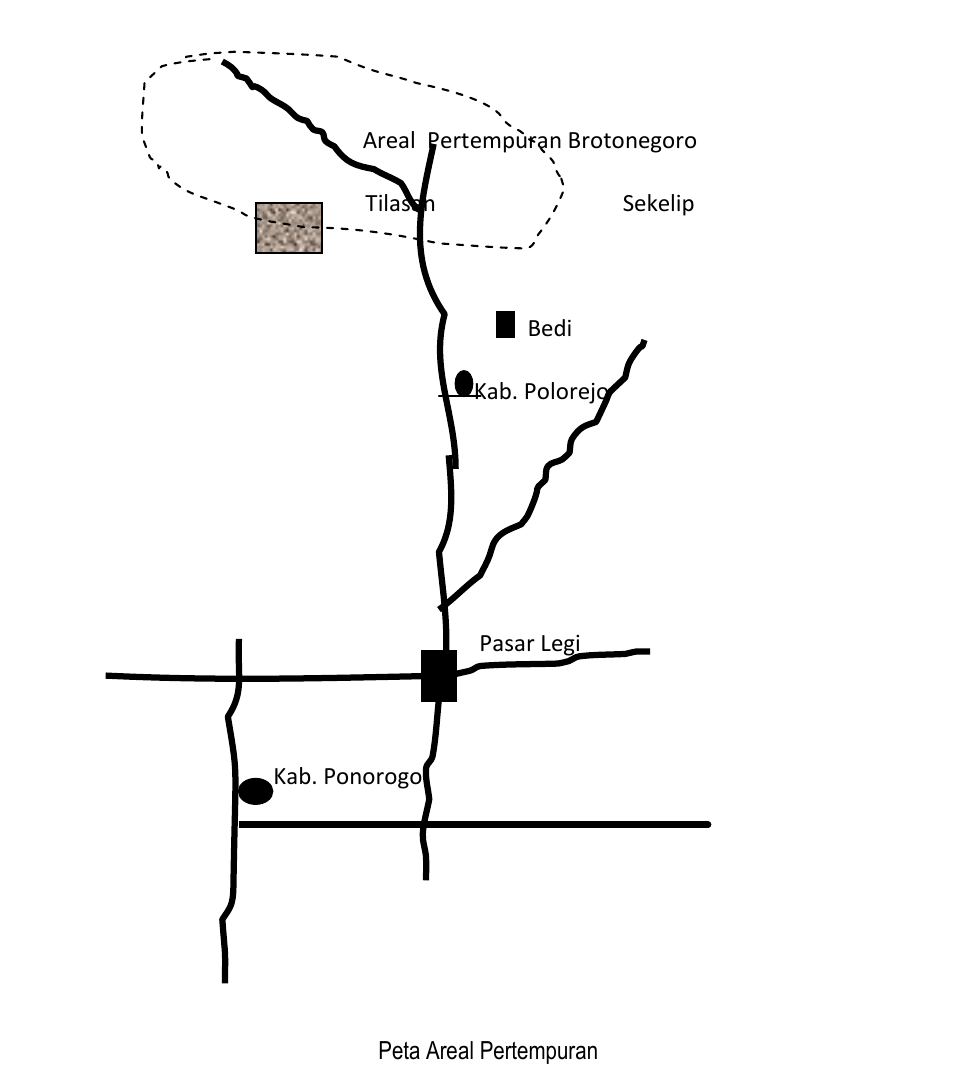
Before the Dutch arrived in the wewengkon (territory) of the Polorejo regency, Tumenggung Brotonegoro had already obtained information on the direction from which the Dutch army would attack Polorejo. The information from the tumenggung’s teliksandi (spies) stated that the Dutch would enter and attack from the north-west, namely the Magetan area. The tumenggung therefore built a calon (bakal, i.e. provisional) pesanggrahan (encampment) about 2.5 km south-west of the Polorejo regency; the pesanggrahan was made of bamboo, built as a tall tower used to watch for the enemy’s approach. The site where the calon / bakal pesanggrahan was built was later commemorated as a Dukuh (hamlet), namely Bakalan, within the wewengkon of Polorejo. The pesanggrahan built by Brotonegoro’s soldiers stood directly north of today’s Bakalan mosque, about 500 m away.
Brotonegoro’s preparations in building the pesanggrahan were not in vain, and it proved truly useful for watching for the Dutch approach, for the tower of the pesanggrahan was twice the height of a bamboo tree (rong uder in Javanese), and it also served as the command centre for the war.
The war between Brotonegoro and the Dutch could no longer be avoided and did indeed take place in 1825. The battlefield lay south-west of the pesanggrahan. As Tumenggung Brotonegoro rode out to meet the arriving Dutch, followed by many soldiers, a soldier was ordered to strike a gong called the demung as a sign that the Dutch had come, and at the same time as the signal for battle. When the Dutch arrived, the soldier striking the demung gong beat it without stopping, until the horse ridden by Brotonegoro shot off as fast as lightning, ndigar-ndigar (prancing and rearing), to meet the enemy, and the tumenggung looked valiant as a war commander.
The fighting went on until evening drew towards night, when it became very hard to see the enemy, and the Dutch withdrew; many of Brotonegoro’s soldiers were scattered in all directions. The tumenggung, however, had already returned to the pesanggrahan, followed by some of the soldiers. By the time it was fully night, many soldiers were at a loss as to how to get back to the pesanggrahan, because the battlefield area was then still dense jungle. As the soldiers were searching in confusion for the pesanggrahan, one of them suddenly saw a lamp twinkling kerlip-kerlip (kelip-kelip in Javanese) not far from where he stood, straight to the west. They all then said that the twinkling light up there must be the lamp of ndoro (master) Brotonegoro’s pesanggrahan, and so it was: after walking towards the light they met the other soldiers and were able to gather together again. The place where the soldier had struck the demung gong was afterwards named Demung, in the village of Sukosari; the place where Brotonegoro’s horse went ndigar-ndigar was named Tegari, now rice fields within the Polorejo area; and the place where the soldiers spoke of the “kelip-kelip” of the pesanggrahan lamp was named “Sekelip”, within the Polorejo area. The remains (petilasan) of Brotonegoro’s pesanggrahan were named “Tilasan”; there used to be a thicket there called the gerumbul tilasan (Tilasan thicket), which is now rice fields.
On 15 November 1825 the defences of the Madiun regency, which was loyal to Pangeran Diponegoro, were concentrated south of the town of Ngawi, but the troops in these defences came under heavy assault from Dutch forces. From the north they were attacked by Dutch troops led by Theunissen, and from the west by Dutch troops led by Lieutenant Vlikken Sohild together with hundreds of pro-Dutch Jogorogo Surakarta soldiers. In the end the Madiun forces loyal to Diponegoro were thrown into disarray and Ngawi fell into Dutch hands. At that time Diponegoro’s southern-sector defence of Madiun was stationed in the Pacitan regency, with regional commanders under the leadership of Bupati Mas Tumenggung Djojokaridjo, Mas Tumenggung Djimat and Ahmad Taris; but because of the strength of the Dutch forces, at the end of August 1825 Pacitan was taken by Dutch troops.
With the Dutch having crushed Diponegoro’s forces in Madiun, in both the southern sector and the northern sector (Ngawi), the whole Madiun region fell into Dutch hands, and Brotonegoro, Bupati of Polorejo, which was the defensive bulwark of northern Ponorogo, was also routed by the Dutch. Brotonegoro, a valiant Bupati, nevertheless kept blocking the Dutch troops coming from the direction of the town of Madiun and Gorang-gareng, Magetan. Because the troops and weapons were unequal, many of Brotonegoro’s soldiers were killed and the battle became one-sided. As Brotonegoro’s troops grew ever fewer, his Pekatik (groom) nimbly leapt onto the back of Brotonegoro’s horse, then took the horse’s reins and whipped it repeatedly until it shot off at speed towards the north-west.
Seeing Brotonegoro leave the battlefield, spurring his horse very fast, the Dutch gave chase until Brotonegoro climbed to the top of Mount Gombak (Nglarangan), Kauman, Somoroto. The top of this small hill was uninhabited, so it was very easy for the Dutch to surround the hill from below. Once the Dutch had surrounded the hill, no native inhabitant was allowed to climb it for a very long time, so that, with no food or drink, after holding out for several months the Bupati Brotonegoro finally met his death. The hill was afterwards named Bukit Larangan (the Forbidden Hill), because of the Dutch prohibition that no one might climb it while Brotonegoro was on top. In the end the Dutch buried Brotonegoro’s body on top of the hill with Islamic rites, and his horse and his pekathik were buried there as well. The former battlefield between Brotonegoro and the Dutch in northern Ponorogo was then named Petilasan, from the word Tilas (Javanese).
The word Tilas takes the ater-ater (prefix) Pe and the penambang (suffix) an to become “Petilasan”; then, dropping the prefix Pe and keeping the suffix, it becomes “Tilasan”. This site lies about 7.5 km north of the town of Ponorogo and is now an area of farmland rice fields in the village of Polorejo.
After Brotonegoro died on the battlefield in a most inhumane manner at the hands of the Dutch, his position as Bupati of Polorejo was taken over by Brotowiryo, from around 1825 to 1829. He was Brotonegoro’s younger brother, and was bupati of Polorejo only briefly, dying within about three years. He was then succeeded by his son-in-law, named Mertomenggolo, from 1829 to 1834.
It was during Mertomenggolo’s rule that the rice granary of Brotonegoro, the first bupati of Polorejo, was moved to Cokromenggalan, to KH. Ghozali’s Pondok Pesantren (Islamic boarding school), to be made into a Masjid (mosque), around 1830. Mertomenggolo was Bupati of Polorejo only briefly, about five years, and was succeeded by Raden Tumenggung Wiryonegoro, son of Raden Tumenggung Brotowiryo, from 1834 to 1837; in that year R.T Wiryonegoro died and was buried in the family cemetery of Raden Betoro Katong at Setono. With this, the Polorejo regency had collapsed and was abolished (dihanguskan) by the Dutch government, together with the Ponorogo Timur regency (Setono/Kota Lama)-(1). Then, around 1849, Ibrahim bin (son of) KH. Ghozali began clearing land in Polorejo, on the land given by Brotonegoro, namely at Bedi, at the same time pioneering the dakwah (propagation) of Islam by founding a pondok pesantren. At that time Ponorogo was under the rule of bupati Raden Adipati Mertohadinegoro, who was Bupati of Ponorogo from 1837 to 1854. On 5-2-1843 he founded the Kauman mosque of the town of Ponorogo, west of the alun-alun (town square), coinciding with 5 Muharam 1259 H, on Sabtu Pahing (Saturday Pahing).
Chapter 6 · p. 14
The Unruly Santri
In 1854 Raden Adipati Mertohadinegoro passed away and was buried at the Tajug cemetery, approximately 4 km east of the town of Ponorogo on the road to Pulung District. In that same year the office of bupati (regent) was entrusted to Raden Mas Tumenggung Cokronegoro I, who governed the Regency of Ponorogo from 1854 to 1856. During Cokronegoro’s administration, a Pondok Pesantren Bedi (Islamic boarding school) already stood in the hamlet of Bedi, Polorejo Village, named after the place where the pesantren was located. It is said that its santri (students) numbered in the hundreds, and by the standards of the population of the time, a few hundred santri was enough to make it quite well known. The santri came from Central Java and East Java; most of those who came to this pesantren did so to memorise the “Al-Qur’an”, because Mbah Ibrahim was indeed a Kyai who had memorised the Qur’an and had a thorough mastery of its writing, its recitation and the content of the tafsir (exegesis) of the verses of the Al-Qur’an.
The santri of Pondok Pesantren Bedi were well known for being rowdy (brawokan) and fearless. One day K. Ibrahim told them to take part in communal work (ro’an.jw) cutting bamboo in the hamlet of Bakalan, approximately 1.5 km north-west of Bedi, as the bamboo was to be used to build the pondok. After they had finished cutting the bamboo they carried it on foot from Bakalan to Bedi along the Ponorogo–Magetan road. All along the way the hundreds of santri carrying the bamboo shouted to their hearts’ content, and not infrequently some of them carried the bamboo poles crosswise (dipikul malang-jw) across the road, greatly disturbing the other people travelling along that road.
It so happened that at that very moment the Adipati (Regent) of Ponorogo, R.M.T Cokronegoro, was travelling along the road the bamboo-carrying santri were using; he was on his way with his family to carry out an inspection of the North Ponorogo area, and he felt greatly disturbed. The Adipati stopped his kereta bendi (horse-drawn carriage) and questioned the reckless, mbeling (unruly) young men, but the santri did not answer the Adipati’s questions properly; instead they mocked him and made fun of him. The santri, however, did not realise that the person they were facing was Adipati Cokronegoro; they had no idea at all that the man they were mocking and teasing was the most powerful person in the land of Ponorogo.
After the incident had passed, a week later K. Ibrahim was summoned (di timbali) to appear before Kanjeng Raden Mas Tumenggung Cokronegoro, to give an account of his santri’s behaviour towards the Regent, who had been mocked on his journey to the North Ponorogo area.
K. Ibrahim was a patient, wise and wira’i (scrupulously pious) kyai, and he immediately begged forgiveness for the behaviour of his santri, which had seemed unruly and impudent. After the two of them had talked for quite a while, and each came to understand who K. Ibrahim really was and who R.M.T Cokronegoro was, no sanction was imposed on K. Ibrahim’s santri. Cokronegoro was the son of Kanjeng Kyai Hasan Besari of Tegalsari; he was a Muslim Adipati Tumenggung, the father of Cokroamiseno, elder brother of HOS Cokroaminoto(3). K. Ibrahim left the regent’s residence (dalem kabupaten) and went home with a relieved heart, for the Kanjeng Adipati had turned out to be generous-hearted and quick to forgive.
Chapter 7 · p. 15
Honouring the Thieves
Every night it was K. Ibrahim’s habit to spend much time writing out the Al-Qur’an after the ’Isyak (night) prayer and after reciting (ngaji) with his santri (students). He did this as a matter of routine, mindful of how important the Al-qur’an was for his santri, since at that time there were no printed Qur’ans sold on the open market. Meanwhile, requests from the santri’s parents (wali santri) to own an Al-Qur’an could no longer be refused, and indeed this was also an obligation for K. Ibrahim in carrying out his mission, as one of his means of da’wah (preaching), namely so that the community could read the Qur’an bin Nadlor (by reading from the text).
One night, when he was tired and sleepy after writing the Al-Qur’an, three men entered Mbah K. Ibrahim’s house without permission, intending to steal his valuables. At that moment Mbah Ibrahim was already fast asleep on his amben kanthil (wooden bench-bed) and did not know that three thieves had entered his house. As subuh (dawn) approached, it was K. Ibrahim’s habit to rise from sleep for the night prayer, followed by Nyai Ibrhim. On waking, as he was about to get down from the amben, he was startled to see men sleeping on the floor near the Kyai’s bed; they were not dressed as santri but as thieves, complete with tools for stealing. K. Ibrahim got up and woke Mbah Nyai, but because he was known as a patient and wira’i (scrupulously pious) man, he let the thieves sleep on soundly, and did not call his santri to seize them. Instead he went to the chicken coop and took his rooster to be slaughtered, and told Mbah Nyai to quickly light the fire (cethik geni) to cook rice and the rooster.
Dawn arrived; many of the santri went to the well to draw water for wudlu (ablution) and some were already beating the bedug (drum) as the signal that prayer time had begun, yet the thieves still did not wake. After his ablution, K. Ibrahim went to the mosque to pray subuh in congregation with the santri, followed by dzikir (remembrance of God) and study of the kitab kuning (classical texts), namely fiqih (jurisprudence) and tauhid (theology).
When the study session was over he returned home and looked to see whether the three sleeping thieves had woken up yet — and, oh, they had not. He went on to the kitchen to help Mbah Nyai continue the cooking she had left to pray subuh. Before long breakfast was ready to be served; Mbah Nyai laid the food out on the dining table, and when that was done K. Ibrahim went to the bedroom and woke the thieves sleeping on the floor. When the thieves were called and woken by K. Ibrahim, they were startled and flustered to see him sitting in a chair, neatly dressed, with a serban (turban cloth) draped around his neck. The sunlight was already shining brightly through the gaps in the roof tiles of the Kyai’s house; the thieves were all bewildered and visibly ashamed. They whispered among themselves and then apologised, because they had come into the Kyai’s house without permission with bad intentions — nothing other, they said, than wanting to steal.
After hearing their confession K. Ibrahim asked why they had gone to sleep instead of stealing. They answered that, as far as they could tell, they had not entered a house at all; rather, all night long they had been in a forest, going round and round inside it, wanting to get out but not knowing the way out, and because they were so tired and exhausted they had fallen asleep. K. Ibrahim, with his patience and dignified manner of speaking, invited them to the dining table and asked them to have breakfast together. They looked ashamed, but K. Ibrahim kept inviting them, and so they accepted his invitation.
After breakfast they were allowed to go home, and Mbah Ibrahim gave each of them one bathok (a coconut-shell measure) of rice to take home. They thanked Mbah Ibrahim for his kindness before leaving, and Mbah Ibrahim in turn thanked the thieves for their kindness in having guarded his sleep and his house all night, so that it was only fitting that they should be honoured(4). Before taking their leave they promised never to steal again and to work to earn a halal living for their daily food.
Chapter 8 · p. 16–17
The Price of an Al-Qur'an
In the land of Java in K.Ibrahim’s time, few people owned a copy of the holy Al-Qur’an. Copies existed only at the Keraton Solo (Solo Palace), the Sultanate of Demak, or at other pondok pesantren (Islamic boarding schools). Even then there were only a few, because the technology of the time did not yet allow the Al-Qur’an to be printed. Paper, the raw material for making books, was itself still an unfamiliar thing, let alone printing presses. This situation was a matter of deep concern to KH. Ibrahim as a hafidl (one who has memorised) of the Qur’an.
Mohammad Nor Ikhwan, in the book Belajar A-qur’an published by Rasail, Semarang, in 2005, quotes the opinion of Subhu Sholih, saying: the Al-Qur’an was printed for the first time in Bunduqiyah (Venice), Italy, in 1530 CE / 936 AH, but when the printed Mushhaf appeared, the church authorities immediately issued an order to burn it. Then in 1694 CE / 1105 AH, Hinkelman printed a mushhaf in the city of Hanburg, West Germany; a few years later, around 1698 CE / 1109 AH, Marraci followed in Hinkelman’s footsteps by printing a mushhaf in the city of Padoe, Northern Italy. Regrettably, not a single one of these Mushhaf reached the hands of Muslims at that time. Only later, in 1787 CE / 1201 AH, was an Islamic press established by Maulana Utsman in the city of Sain Petersbourg, Russia, and likewise a similar press was established in Qozan.
Then in Iran two mushhaf were published, one printed in Teheran in 1828 CE / 1243 AH and the other printed in Tibris in 1833 CE / 1249 AH. After that, in 1834 CE / 1250 AH, Flugel founded a press in Leipzig specifically for printing the mushhaf.
Not long afterwards a small, beautiful and very fine mushhaf appeared in Cairo, printed and published in 1932 CE / 1351 AH under the supervision of the Syaikh Al-Azhar (Shaykh of Al-Azhar), and recognised and ratified by a Special Committee formed by King Fuad I. This Mushhaf was written and arranged according to the riwayat (transmission) of Hafs of the qiraat (reading) of ’Ashim.
At the Al-Ghozali pesantren in Cokromenggalan in 1820 CE / 1235 AH there was only one copy of the holy Al-Qur’an, the one belonging to K. Ghozali. In 1847 CE / 1263 AH, when KH. Ibrahim returned from studying (mondok) and from the hajj pilgrimage in the holy land of Makah, he brought back as oleh-oleh (a homecoming gift) an Al-qur’an, which he used to teach his santri (students) to recite the Qur’an. With his skill in writing beautiful Arabic script, KH. Ibrahim set about increasing the number of copies of the Al-Qur’an for his santri to study from.
At first it took KH. Ibrahim a whole year to finish writing out the 30 juz (parts) of the Al-Qur’an, because he did the writing as a side task (samben-jw), that is, after he had finished teaching his santri. Although it was done only on the side, the result was very fine, written in large Nash-style script to make it easy to read. The beginning of each surah was adorned with very beautiful ornaments, likewise every tenth juz, and in the margin of each page there were notes on the reading of particular words according to several Imams. The first Al-Qur’an written by KH. Ibrahim attracted a great deal of attention from the santri, who naturally also wished to own one. Sure enough, one santri was keen to own a handwritten Mushhaf Al-Qur’an by Mbah KH. Ibrahim; plucking up his courage, the santri respectfully asked (matur) him whether he would be willing to write out the 30 juz of the Al-Qur’an for him in exchange for 2 cows. KH. Ibrahim, however, did not grant the request because of how busy he was running the pesantren. The santri was not short of ideas: by pleading over and over, joined by his parents as well, he finally got KH. Ibrahim to accept the order, on condition that he be patient.
In the end, within six months, the handwritten 30-juz Al-Qur’an was completed just as the santri who had ordered it had hoped. Mbah KH. Ibrahim wrote this Al-Qur’an in the middle of the night after performing the tahajud prayer, using a dip pen made from sodo aren (the rib of a sugar-palm leaf) and bak ink (Chinese ink). As had been promised, the payment of 2 cows was duly fulfilled by the santri, and the cows were then sold to pay for the construction of the pesantren, a place for wudlu’ (ablution), gothaan (santri dormitories) and repairs to the mosque(6).
KH. Ibrahim’s diligence and skill in writing the Al-Qur’an evidently became known far and wide: people from Banyuwangi and from Kedu in Central Java also ordered handwritten copies of the Al-Qur’an from KH. Ibrahim. For a single Al-Qur’an handwritten by KH. Ibrahim, some of them were willing to pay Rp 50,- (fifty rupiyah), at a time when a cow cost around Rp 10,- (ten rupiyah). The cucu, buyut, canggah and wareng (grandchildren down to great-great-great-grandchildren) of today can compare that with what a cow costs now……? According to some accounts, KH Ibrahim succeeded in writing 11 copies of the holy Al-Qur’an in his lifetime that were ordered by others, and several more that he gave to his children and grandchildren. One of them, the first Al-Qur’an written by KH. Ibrahim and used for his personal reading, is kept by K. Muslih Al-Baroni, who made slides of it (di slaitkan) to be shown in the TALI book printed on 10 July 2006 at the Silatul Arham (family reunion) in Karangtengah, Baron, Nganjuk, at the house of KH Mukhlas Ghozali.
KH. Ibrahim did not only write the Al-Qur’an but also wrote salafiy books, or kitab kuning (classical texts), which were the core subjects of study in the pondok pesantren when he was still a santri at Pondok Pesantren Tegalsari, such as books of Fiqih and Tauhid, and even books containing do’a (prayers) and aurod (litanies). The Al-Qur’an written by KH. Ibrahim that is still carefully kept today by P. Suharto, a former Secretary of Kertosari Kelurahan (sub-district) and a great-grandson of one of KH. Ibrahim’s santri, is historical evidence that can serve as tangible proof that KH. Ibrahim was truly an expert in writing the Al-Qur’an. More convincing still, tucked inside the Qur’an kept by P. Suharto there are still 2 sodo aren sticks whose tips have been split (di pegas) like the tip of a pen, specially for writing khoth arab (Arabic calligraphy).
Chapter 9 · p. 17
Deep Compassion for All of Allah's Creatures
Though renowned as ’alim (learned) and highly knowledgeable, KH. Ibrahim was not marok (arrogant) and no warokan (swaggering strongman); rather he was a wira’i (scrupulously pious) and patient man, always humbling himself before those who were keminter and gemuru (know-it-alls and boastful). He did not like minteri and ngguroni (lecturing others or acting the teacher), did not display his cleverness or his standing as a teacher, and was very simple in appearance. He was patient and gentle towards all of Allah’s creatures, not only towards people but towards animals as well: so patient was he that if chickens ate the paddy he had put out to dry, he would not shoo them away — out of pity, he said, because humans had already been given so many blessings by Allah.
When he was about to pass along a road where birds were perched on the branches of the trees by the roadside he was going to walk along, he would stop and wait patiently until the birds flew off of their own accord, without being disturbed by him.
Indeed, not a few people tell, in stories handed down from generation to generation, that no one’s patience could surpass the patience of Mbah K. Ibrahim Bedi. According to stories in the community to this day, it is said that in the past, if K. Ibrahim was about to go along a road and came across birds looking for food on the path he meant to take, he would give way and look for a shortcut (terabasan), and not go along the road where the birds were feeding. In Javanese: “Pilih golek dalan liyo (nrabas) katimbang ganggu manuk sing lagi golek pangan” (“Better to find another way (cutting across) than to disturb birds that are looking for food”).
Chapter 10 · p. 17–18
Mbah Kombong
Pondok Pesantren Bedi once enjoyed a golden age, famous across the island of Java and Madura, and many santri (students) came to this Pesantren Bedi. Among them was one santri whose laqab (nickname) was Kombong.
The santri Kombong came from the town of Mbegelen, Purworejo - Yogja - Central Java, and this santri had a distinction all his own. From the time he became a santri he was very obedient and devoted to his Kyai, given to prihatin (self-denial) and fasting, and diligent in study, so much so that even after completing (khotam) a book many times over he still liked to go over it again and again. He took great joy in serving Mbah K. Ibrahim and paid no heed to himself, so that when he reached marriageable age and was told to marry by Mbah Ibrahim, he did not take the instruction very seriously; indeed it was as if he had made a vow “to keep serving K. Ibrahim until he died”.
Kombong’s peculiarity was that he did not like to leave his kombong gotha’an (dormitory cubicle) unless he needed to study with K. Ibrahim; because of this habit he was called Mbah Kombong (his real name is not known). Kombong grew older and older yet remained a bachelor, and K. Ibrahim too grew older, but Allah took Kombong’s life before K. Ibrahim’s. Before Kombong passed away he respectfully asked (matur) Mbah Ibrahim that, should he die at any time, Mbah Ibrahim would kindly bury his body on Mbah Ibrahim’s own land. And indeed Kombong was the only santri who died at Pesantren Bedi and the first to be buried on Mbah Ibrahim’s private land; K. Ibrahim later endowed (di wakafkan) the land around his grave as a cemetery for the Muslim residents around Polorejo. Mbah Ibrahim then gave the santri Kombong’s grave its own boundary, and no one else was allowed to be buried to its right or left besides Kombong’s grave, and to this day Mbah Ibrahim’s command is still upheld. When the public cemetery was fenced all round by the Village in 2009 (the Head of Polorejo Village at the time being Drs. Aman Suhermanto), Mbah Kombong’s grave was still given a fence and kept within its own kombong (enclosure). Mbah Kombong’s grave lies to the north of K. Ibrahim’s family graves, behind Masjid Bedi.
Chapter 11 · p. 18
Twelve Years a Santri Without Ever Going Home
Different from Mbah Kombong is the story of a santri (student) known by the name Noer. He was a santri whose home was not far from the pondok (boarding school) of Bedi, about 1 km to the south-east, in the hamlet of Tamanan to be precise. According to H. Muryani (grandson of Mbah Noer), he recounted:
My grandfather also once boarded (mondok) at Pesantren Bedi, and while boarding at Bedi he never went home for twelve years, even though his house was not far from Pondok Bedi. When my grandfather told me this, I asked:
“Why did you never go home, Grandfather?”
My grandfather answered:
“Because I felt more krasan (at home) at the pondok, and besides that, I truly wanted to be closer to Mbah Kyai Ibrahim, seeking tabarukan (blessing) from his learning (’aliman)”.
Was there any other reason besides that, Grandfather?
Grandfather answered:
“Yes, there was, because at that time I had a wish: until I owned a kitab (book) written by K. Ibrahim himself, I did not want to go home”.
Which books were they, Grandfather, the ones you wanted?
Grandfather answered:
“Well, books of fiqh and tauhid, because at the pondok we did not mligi (only) memorise the Al-Qur’an, but were also given wulangan (lessons) in fiqh, tauhid and hadits”.
And was your wish granted, Grandfather?
Grandfather answered: “Alhamdulillah, your mbah buyut (great-grandfather) then sold one of his buffaloes to order the book I wanted from Mbah Ibrahim, and then I went home.
Chapter 12 · p. 18–20
Tales of Karomah
Able to Climb Up but Not to Climb Down
In broad daylight, someone set out to steal coconuts belonging to Mbah K. Ibrahim; the coconut tree stood right on the south side of the yard of his house. When the thief climbed the coconut tree, no one knew when or at what hour. As he was about to go to the tegal (dry field) near his house, he passed beneath the coconut tree and, quite unexpectedly, there at the top of the tree was a man stuck fast (tergencet) — able to climb up but unable to climb down — and apparently the coconut thief had already been up the tree for a long time.
At that time many coconut trees were planted around Mbah K. Ibrahim’s house and yard, and it was his habit every morning and midday to look around the tegal, and without fail he would also often look up at the coconut trees in case any were ready to be picked. Unexpectedly, as he was heading to the tegal in front of the house, he heard someone shouting for help, and Mbah Ibrahim quickly turned his steps and his gaze towards the place where the person was calling for help.
The thief told Mbah Ibrahim that he repented and would not repeat his deed. Mbah Ibrahim forgave him and told the thief to come down, but he said he still could not come down; though he was told to come down again and again, his feet and hands remained stuck to the coconut tree and could hardly be prised loose. In the end Mbah K. Ibrahim went home to fetch a ladder (ondho-Jw) and leaned it against the coconut tree with the thief in it. In fact the ladder was not very long, yet when it was leaned against the coconut tree its length reached the full height of the tree, and so the thief was finally able to climb down with ease.
Once he reached the foot of the coconut tree, the thief took his leave of Mbah K. Ibrahim, promising never again to repeat his shameful deed.
The Semut Geni, Guardians of the Kyai’s House
Maling, begal and rampok (thieves, highway robbers and bandits) were commonplace in Mbah K. Ibrahim’s lifetime. Thieves in those days usually did not prise open doors or windows; instead they dug under the foundations of people’s houses until they broke through to the inside, and that was how the thief got in. Mbah K. Ibrahim’s house, too, was often targeted by thieves, but they always failed, and the thieves never learned their lesson either. One night a thief dug under the foundation of Mbah Ibrahim’s house from the back. When the hole was nearly finished and about to break through into the house, the thief was suddenly swarmed by semut geni (fire ants), whose bite feels terribly itchy and burning, and the bitten skin is sure to swell up.
Strangely, the thief only became more determined; he moved elsewhere and dug under the foundation again from the east side of the house. But strangely, every time the hole was nearly done and the thief was already inside it, the fire ants came to attack. This went on until, in a single night, there were as many as five holes, all of them failures, and in the end the gang of thieves surrendered to Mbah Ibrahim and asked to be given a jampe (healing incantation) as an antidote to the fire-ant bites (minta di jampeni, i.e. diobati, “to be treated”).
Testing the Miraculous Power of Mbah KH. Ibrahim’s Grave
There was a young man who had often heard from a mubaligh (preacher) that when a person who was hafidl qur’an (had memorised the Qur’an) died, neither their shroud nor their body would decay. According to eyewitnesses, the young man then took it into his head, on a whim, to prove what he had heard from the preacher. His thoughts suddenly turned to the late Mbah KH. Ibrahim, who was said to have been a hafidl qur’an and an expert writer of the Al-Qur’an. One night, accompanied by his younger sibling, he took a ganco (pickaxe) to Mbah KH. Ibrahim’s grave, intending to dig it up and prove the truth of the preacher’s words.
He truly carried out his intention without the slightest fear or trepidation. On reaching Mbah Ibrahim’s grave, he dug the earth with the pickaxe, and when the digging reached a depth of approximately 30 cm, suddenly water gushed out of the grave with tremendous force, so that the pickaxe he was gripping shot out of his hands and was flung approximately 7 m, striking the maesan (grave marker) of Mbah Ibrahim’s grandchild — and the chipped grave marker remains as a witness that cannot be erased.
The deed was carried out by the perpetrator in approximately 2004, so that if Mbah K. Ibrahim died around 1917 CE, then for 87 years after his death Allah’s ma’unah (divine aid) continued to protect him.
Allah is indeed Supreme in all things — Most Just, Most Wise, All-Knowing and Most Perfect. And not long after the attempt to dig up Mbah KH. Ibrahim’s grave, the young man himself met his end. May Allah receive his soul with full forgiveness and mercy. Amiin.
Chapter 13 · p. 20–22
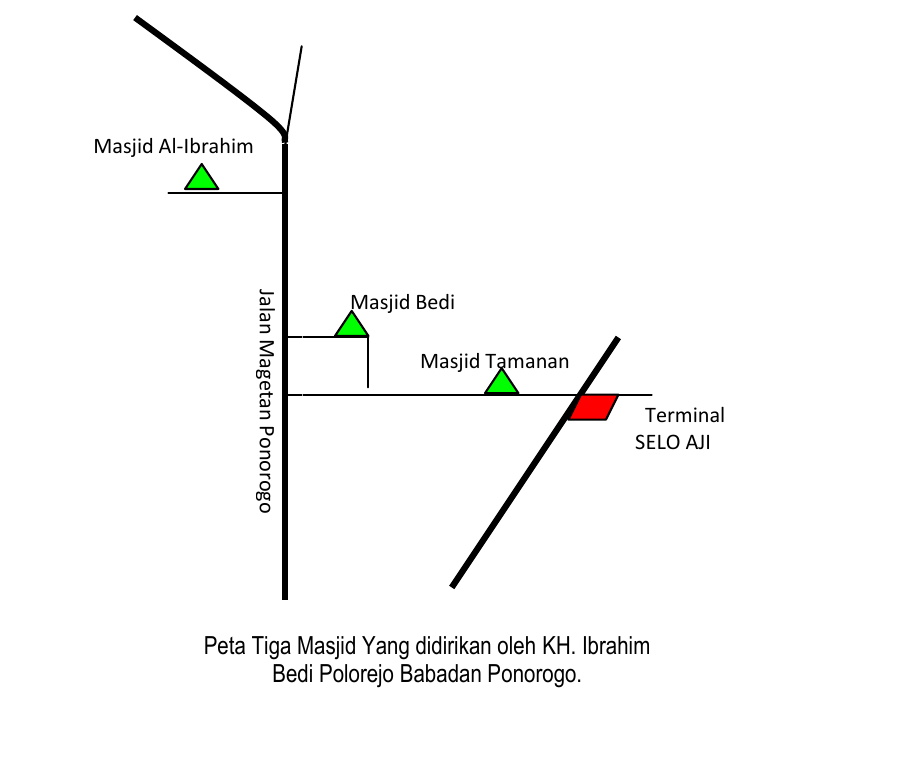
Mbah K. Ibrahim Builds Three Mosques
Around 1848-1849 CE, K. Ibrahim began clearing (babad) the land of Bedi and at the same time built a house to live in with his wife, a mosque, and founded a pondok pesantren (Islamic boarding school). In the early days of the clearing, his santri (students) were sent from his abah’s (father’s) pesantren in Cokromenggalan, and over time it became self-sufficient, with many santri coming from all corners of Java and Madura.
During his marriage to his wife, named Sudjinah, KH. Ibrahim was blessed with six sons and daughters, namely:
- Roisah
- Zainab
- Mardjiyah
- Ridwan
- Sudjinah and
- Syarifah.
Masjid Tamanan
His second daughter, Zainab, was married to one of his santri named Umar from Dukuh (hamlet) Tamanan, Polorejo Village, approximately 1 km south-east of Bedi. After Zainab married Umar, K. Ibrahim built a Masjid (mosque) for Umar on land belonging to Umar’s parents, who were well known at the time as very wealthy, namely in Tamanan, in the hope that Umar could help him in Islamic da’wah (preaching) in Polorejo.
The mosque stood on the bank of the river south of the hamlet of Pule, Polorejo. Relative to the present mosque building, the site of the first mosque lies approximately 100 m to its north; it has been renovated several times, and with each renovation it also moved southwards, so that it came close to the main road, as it is today.
The marriage of Zainab and KH. Umar was blessed with eight sons and daughters, namely:
- Abu Rozi, born in 1910, married a woman named Supiyah; the two of them then lived in Sudimoroharjo-Wilangan-Nganjuk.
- Abdul Rosyid or H. Syarif, born in 1912, married Umi Saroh and lived in Mentaos-Kertosono-Nganjuk.
- Sahlan, born in 1914, married Rusmiyatun and lived in Rejosari-Darungan-Pare-Kediri.
- Robi’atun, born in 1916, lived in Plalangan-Jenangan-Ponorogo.
- Qusyairi, born in 1918, married Djuwariyah and lived in Paron-Gampengrejo-Kediri.
- Roulah, born in 1920, married Munajat and lived in Tegalsari-Ngandong-Banyuwangi.
- K. Soebari, born in 1922, married Kadisah and had one child, then they separated (furqoh); he then remarried, to Ny. Sami, and was blessed with five sons and daughters. It was this K. Soebari who later succeeded KH. Umar as Kyai of Masjid Tamanan.
- K. Hayat, born in 1924, married Ny. Robi’ah and lived in Dukuh Tamanan, Polorejo, Babadan. It was he who eventually succeeded to the position of Kyai of Masjid Tamanan after the death of K. Soebari, and who was at the same time the last Kyai descended from K. Ibrahim to serve as Kyai at Masjid Tamanan, since the mosque underwent a total restoration by the community of Dukuh Tamanan.
Why is K. Hayat called the last Kyai descended from K. Ibrahim at Masjid Tamanan? Because when K. Hayat died his sons were still too young to be appointed Kyai; and when one of his sons — the eldest of K. Hayat and Hj. Maimunah, named H. Syamsudin — came of age, he was appointed a state official and carried out his duties out of town, in Jombang.
Then in 1996 the Tamanan mosque founded (babadan) by Mbah K. Ibrahim underwent a total renovation by the community of Dukuh Tamanan, as the building was indeed in need of restoration. At that time H. Syamsudin’s younger brother, named Imam Suhadi, was still regarded as too young to be made Kyai, though in the author’s opinion Imam Suhadi’s age at the time was already suitable for him to be installed as Kyai, since in 1996 he had already reached 32 years of age. So, up to the time this was written, who is the established Kyai of Masjid Tamanan? The answer is: “nobody yet!”.
Perhaps, though, carried along by a character inherited through nasab (lineage) — like the character of Mbah Ibrahim, who was humble, patient, and disliked riya’ (showing off), let alone takabur (arrogance) — Imam Suhadi did not wish to come forward as Kyai even though the community had asked him to, and perhaps he felt that since the mosque had become entirely the property of the community of Dukuh Tamanan, it would be better for its Kyai to come from among them.
Masjid Bakalan
When KH. Ibrahim’s fourth child, Ridlwan, reached adulthood, he was married to a young woman from Kradinan, Jetis, Ponorogo, named Taslimatun. After they had been married for some time, KH. Ibrahim prepared for the two of them a field for spreading the religion of Islam (berdakwak) at a place not far from Bedi, namely Dukuh Bakalan. KH. Ibrahim founded a mosque in this hamlet, and Ridlwan and his wife were to take up their new home there in Dukuh Bakalan, as Kyai of the mosque newly founded by his abah (father). Thus Ridlwan naturally made his home with his wife in Bakalan and developed the teaching of Islam there, always attended by his father, KH. Ibrahim. For after building the mosque in Bakalan, KH. Ibrahim spent much of his time at this son’s home (Bakalan) as he grew older, and he handed over the management of his Pesantren in Bedi to his son-in-law from Kradinan Jetis, named K. Imam Rozi, husband of Ny. Syarifah, KH. Ibrahim’s youngest or sixth child.
Although the Bakalan mosque has been restored several times, its location and position have not changed; where it stood in the past is just where it stands now.
After the death of K. Ridlwan, the position of Kyai of Masjid Bakalan was taken over by KH. Asyhuri, the second son of K. Ridlwan, who was born in 1912 and died in 2007 CE. And it appears that after the death of K.Ashuri, succession to the position of Kyai of Masjid Bakalan by a descendant of K. Ibrahim is in danger of being broken, because those who remain there are the children-in-law, while his two sons who would have been fit and proper to succeed K. Asyhuri have both become state officials. One, KH. Muhaimin, became Head of the KUA (Office of Religious Affairs) in Gresik, and the other, K. Ahmad Syafi’i, became a lecturer at UNTAG Surabaya, and both have settled with their families in Surabaya.
May there grow up, in times to come, successor generations of KH. Ibrahim in the places he founded. Amiin!
Masjid Al-Ibrahim
Around 1878 CE, KH. Ibrahim’s youngest daughter, named Syarifah, was married to Imam Rozi from Kradinan, Jetis, Ponorogo, son of K. Moh. Sayid, son of K. Tafthojani. Imam Rozi was a santri with ample religious knowledge, so that after he married Syarifah he was gradually entrusted by KH. Ibrahim with helping to teach (ngaji) at his pondok. When Mbah Ibrahim built the mosque for his son in Bakalan, he spent much of his time there, and little by little Pesantren Bedi was handed over entirely to Imam Rozi; the Pesantren developed better and better and the number of its santri also grew.
In his advancing old age KH. Ibrahim no longer lived in his house in Bedi but followed his only son, K. Ridlwan, to Bakalan, since it seemed that Imam Rozi had enough knowledge to run the Pesantren he had founded; yet now and then he would quite often come to Bedi to look in on his santri, and he was called the Kyai Sepuh (Elder Kyai). In 1917 CE, in the month of Jumadal Ula 1335 AH, KH. Ibrahim fell ill from old age, and when his time came he passed away at the age of 105. Mbah KH. Ibrahim’s life was indeed a long one — one could say a century and five years. He died at the home of K. Ridlwan (Bakalan); on hearing the news of the death of their Kyai Sepuh, thousands of santri and many members of the community came to K.Ridlwan’s home to offer takziyah (condolences). According to folk accounts, when K. Ibrahim’s body was to be buried in the Bedi cemetery, it was not carried on people’s shoulders on a bier (bandoso.jw); instead thousands of santri and members of the community stood in a line from K. Ridwan’s house all the way to the Bedi cemetery, and K. Ibrahim’s body was passed along in a chain from hand to hand by these santri and community members, all of them vying for their hands to share in carrying the body of KH. Ibrahim.
Because KH. Ibrahim spent much of his old age in Bakalan and also died there, the mosque he founded in Bakalan was named “AL-IBRAHIM” by the late Mbah KH. Asyhuri.
Chapter 14 · p. 23–24
The Decline of Pondok Pesantren Bedi
In 1900 the Dutch government established private village schools, by order of the Assistant Wedana (now the camat, or district head). Then in 1903 the Dutch government began opening three-year Sekolah Desa (Village Schools) in Banyudono Village and Brotonegaran Village, then in 1904 in Bangunsari village, with teachers from Madiun, from what was called the Premi Opleideng; and by 1911 Ponorogo was already able to graduate two-year Village School teachers.
Then in 1904 the Sekolah ongko I (First Class School) was converted into an HIS (Holand Indische School), where only the children of the priyayi (the aristocratic class) could be admitted as pupils, and the language of instruction was Dutch. In 1905 the Sekolah ongko II (Second Class School) in Bangunsari admitted pupils from among the children of farmers and swasta (private, non-official) families. Subsequently the Dutch government opened Village Schools outside the Town, including in Polorejo Village, where the Dutch established a three-year Village School.
During this period of Dutch colonial rule, schoolchildren were segregated: children of the priyayi were not allowed to attend the same school as children of farmers and swasta families. The priyayi children went to the HIS (the Dutch school), while children of farmers and swasta families had to attend the three-year Village School, followed by 2 (two) more years at the Sekolah ongko II; children of farmers and swasta families could attend the HIS only if they held the title Raden.
Because of pressure from the Dutch that the children of farmers and swasta families must be sent to the three-year village schools — together with permanent school buildings, and the pamong desa (village officials) who were ordered to herd the farmers’ children into the three-year village school every day — this was what caused the Pondok Pesantren (Islamic boarding school) in Bedi to decline.
In 1926, nine years after the death of KH. Ibrahim, the modern pondok of Gontor was founded, and the Dutch government then also established public schools that admitted pupils from all walks of life — children of priyayi as well as of farmers and swasta families could attend these public schools. After the Dutch government established public schools, the Muslim community also set up private schools with an Islamic character, among them from the Muhammadiyah organisation, followed by Nahdlatul Ulama’, which also founded Sekolah Dasar (Primary Schools).
Pondok Pesantren Bedi at that time was a very traditional pondok: its KBM (Kegiatan Belajar & Mengajar, teaching and learning) buildings consisted of angkring (raised, open-sided) structures made from bamboo poles and roofed with woven coconut fronds and damen (dry rice straw), as were the lodging buildings for the santri (students). Then, after the death of KH. Ibrahim in 1917 CE, Pondok Pesantren Bedi was continued by his son-in-law from Kradinan Village, Jetis, Ponorogo, namely KH. Imam Rozi, whose nasab (line of descent) traces back to K. Noyopuro (teacher of K. Mohammad Kasan Besari of Tegalsari, Jetis). He was the husband of Ny. Hj. Syarifah, the youngest child of KH. Ibrahim, with the following line of descent:
- Syaikh Jamaludin Jumadal Kubra – Trowulan, who had a son:
- Sayid Maulana Ibrahim Asmorokondi – Tuban, who had a son:
- Syaikh Maulana Ishaq – Malaysia, who had a son:
- Sayid Abd. Qodir Pandanarang I – Semarang, who had a son:
- Sunan Tembayat Pandanarang II – Klaten, Central Java, who had a son:
- Ki Ageng Sumendhe – Setono Jetis Ponorogo, who had a son:
- Pangeran Kabu – Setono Jetis Ponorogo, who had a son:
- Prabu Ratmaja – Setono Jetis Ponorogo, who had a son:
- Kyai Noyodipuro – Setono Jetis Ponorogo, who had a son:
- Kyai Isma’il – Kradinan Jetis Ponorogo, who had a son:
- Kyai Mardliyah – Kradinan Jetis Ponorogo, who had a son:
- Kyai Tafthojani – Kradinan Jetis Ponorogo, who had a son:
- Kyai Mohammad Sayid – Kradinan Jetis, who had a son:
- Kyai Haji Imam Rozi – Bedi Polorejo
Tracing the nasab of KH. Imam Rozi through his mother’s line, he is also connected by descent to Raden Bethoro Katong, in the following order:
- Prabu Brawijaya V Bhre Kertabumi – Majapahit, who had a son:
- Bethoro Katong, Bupati (Regent) of Ponorogo, who had a daughter:
- Ny. Ageng Sumendhe, who had a son:
- Pangeran Kabu – Setono Jetis Ponorogo, who had a son:
- Prabu Ratmaja – Setono Jetis Ponorogo, who had a son:
- Kyai Noyodipuro – Setono Jetis Ponorogo, who had a son:
- Kyai Isma’il – Kradinan Jetis Ponorogo, who had a son:
- Kyai Mardliyah – Kradinan Jetis Ponorogo, who had a son:
- Kyai Tafthojani – Kradinan Jetis Ponorogo, who had a son:
- Kyai Mohammad Sayid – Kradinan Jetis, who had a son:
- Kyai Haji Imam Rozi – Bedi Polorejo
When Pondok Pesantren Bedi was under the care of KH. Imam Rozi, competition in education began between the angkringan pesantren and the formal education that the Dutch government had established in the villages of Ponorogo Regency; and because of the limited facilities and infrastructure at the time, Pesantren Bedi gradually declined further and further until only traces remained to preserve the history of the pesantren world in the North Ponorogo area, followed too by the death of KH. Imam Rozi around 1940 CE.
Chapter 15 · p. 30
Pondok Pesantren Setono, Jetis, Ponorogo
If KH. Ibrahim’s nasab (line of descent) is traced through his grandmother’s line, namely Ny. Nawawi Majasem, he is a descendant of Kyai Ageng Noyodipuro of Setono Village, Jetis, Ponorogo — that is, a great-grandchild of Pangeran Sumendhe, who babad (cleared the forest to found) the village of Setono. Pangeran Sumendhe was the son of S. Muhammad Hidayatullah, also known as Sunan Pandanarang II or Sunan Tembayat, who died and was buried at Mbayat, Klaten, Yogjakarta.
Pangeran Sumendhe had a child, K. Pangeran Kabu, who had a child, K. Pangeran Ratmojo, who had three children:
- K. Ageng Donopuro
- K. Ageng Noyopuro
- Ny. Mukminah
K. Donopuro founded a pondok pesantren (Islamic boarding school) and a mosque on the land cleared by his great-grandfather (P. Sumendhe). He was a Kyai (religious teacher and scholar) whose character was “Berbudi bawa laksana” (a Javanese expression for one who is noble-minded, generous and true to his word); his name was well known and he was deeply ’alim (learned), expert not only in the Qur’an but also in ilmu bathin (inner, spiritual knowledge). The progress of his pesantren was supported by his brother, K. Ageng Noyopuro.
The santri (students) at this pondok came not only from the town of Ponorogo but also in large numbers from further afield, including Mohammad Kasan Besari and his younger brother Nor Shodiq, from the village of Kuncen, Caruban, Madiun. Both were sons of K. Anom Besari.
Mohammad Kasan Besari was known for being diligent and sregep (hard-working, eager); before long at the Setono pesantren he had memorised the Qur’an together with its meaning (translation). K. Donopuro paid him special attention, because he himself had no descendants. In the end, this favourite student was married to K. Donopuro’s own niece — namely the daughter of Ny. Mukminah, the wife of K. Nur Salim.
K. Nor Salim was the son of Pangeran Buntoro, also known as K. Dhugel Kesambi of Ngloning, the son of R. Tumenggung Joyonegoro, Bupati (regent) of Gadingrejo, Tamansari, Sambit, Ponorogo. K. Nor Salim also had a pondok pesantren in Ngasinan Village, in the hamlet of Mantub, so he became known as Kyai Mantub; it was located not far from K. Donopuro’s pesantren, ± 2.5 km south of the village of Setono, Jetis.
A few months after Mohammad Kasan Besari’s marriage, K. Donopuro instructed him to begin clearing the wild forest, and to start the clearing from K. Donopuro’s own tegal (dry field), which lay to the east of the Setono pondok, not far away, separated from it only by a river. Accordingly, once the clearing was finished he built a Langgar (small prayer house), and the cleared land was given the name “Tegalsari” (9).
In time, K. Donopuro told Mohammad Kasan Besari to establish a pondok pesantren, and his Langgar was converted into a Masjid (mosque). Once the pondok founded by K. Mohammad Kasan Besari was completed, K. Donopuro passed away, followed by K. Ageng Noyopuro, after which the santri all moved together to K. Mohammad Kasan Besari’s pondok at Tegalsari.
Looking far back into this history, it is no surprise that KH. Ibrahim was someone who had memorised the Qur’an and was also a fine copyist of the Qur’an, given that his ancestors came from the Setono pondok pesantren in Jetis, Ponorogo, whose Kyai were likewise experts in the Qur’an.
Chapter 16 · p. 31
The Kitab Left by KH. Ibrahim
- Al-Qur’an Juz Amma (the 30th and final part of the Qur’an), handwritten by KH. Ibrahim
- Al-Qur’an, all 30 Juz (parts), handwritten by KH. Ibrahim
- Hadits (collected sayings and traditions of the Prophet), handwritten by KH. Ibrahim when he was 11 years old
- Fiqih (Islamic jurisprudence):
- a. Taqrib, handwritten by KH. Ibrahim
- b. Fathul Qorib, handwritten by KH. Ibrahim
- c. Tahdzib, handwritten by KH. Ibrahim
- d. Al-Bajuri, handwritten by KH. Ibrahim
- Tauhid (the doctrine of the oneness of God)
- Do’a - Do’a (prayers and supplications)
All the surviving kitab (religious books/manuscripts) handwritten by the late KH. Ibrahim Ghozali were gathered together again by his buyut (great-grandchildren) and canggah (great-great-grandchildren) and stored in a special almari (cabinet) filled with the late KH. Ibrahim’s books, from 20 Robi’ul Awal 1432 H / 24 Pebruari (February) 2011 M. They can be viewed by family members or the general public in the Serambi (front veranda) of Masjid Bedi.